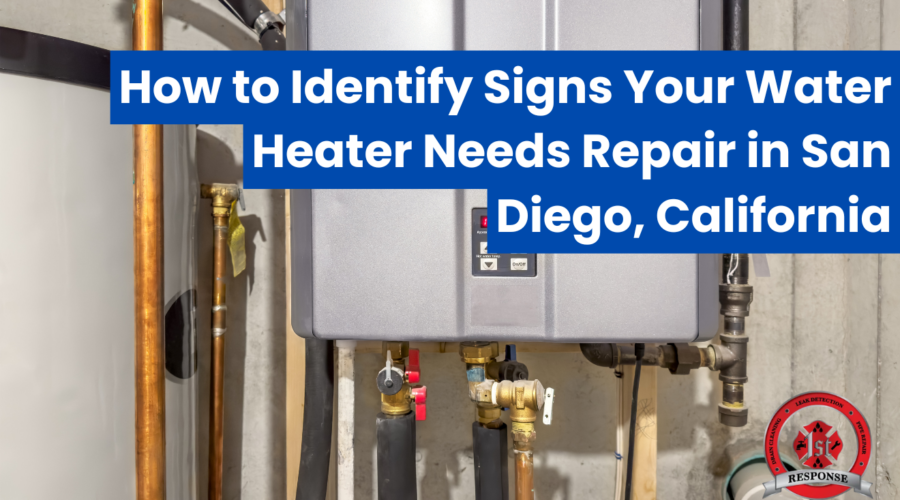
Executive Summary
Most water heater issues San Diego homeowners experience—lukewarm water, no hot water, noises, leaks, and rusty/smelly water—are typically caused by hard-water sediment, aging components, or pressure/temperature stress. Identifying the exact failure early helps control water heater repair cost San Diego residents pay and clarifies when repair is reasonable versus when replacement is the safer, more cost-effective choice.
Key Takeaways
- Hard water sediment is a primary driver of performance problems. Mineral buildup reduces effective tank capacity, slows heating, creates rumbling/popping noises, and increases long-term operating and repair costs.
- Hot water that runs out fast usually points to a small set of fixable causes. Common culprits include sediment buildup, a failing electric heating element, thermostat issues, or a broken dip tube that mixes cold water into the hot supply.
- Leaks require fast triage to prevent property damage and avoid escalating costs. Minor leaks may come from valves or fittings, but a leak from the tank body typically signals terminal corrosion where replacement is more practical than repair.
- Repair cost is shaped more by the underlying component and access than the symptom. Unit type (tank vs. tankless), part price (e.g., gas valve/control board), installation location, and after-hours service largely determine water heater repair cost San Diego homeowners encounter.
- Age and condition determine repair vs. replace value. With many tank heaters lasting roughly 10–15 years, major failures near end-of-life or repeated recent repairs generally favor replacement over continued repair.
In San Diego, the most common water heater problems are lukewarm water, no hot water, strange noises, leaks, and rusty or smelly water—and many can be fixed quickly once you know the cause. For example, if your shower turns cold halfway through, it could be a failing heating element or sediment buildup shrinking the tank’s capacity. If you hear popping or rumbling, that’s often minerals settling at the bottom and overheating, which can sometimes be resolved with a tank flush. A small puddle near the base might come from a loose drain valve or a worn-out T&P relief valve, while rusty water from the tap can point to a corroding anode rod. Knowing what’s happening also helps you estimate the water heater repair cost San Diego homeowners typically face, so you can decide when a simple fix makes sense versus when replacement is the smarter move.
What causes the most common water heater problems in San Diego?
Most issues come down to a few repeat culprits: sediment from hard water, aging parts, pressure/temperature stress, and small leaks that quietly escalate. Understanding the “why” helps you judge whether you’re facing a simple service call or a higher water heater repair cost San Diego homeowners should plan for.
Lukewarm water or hot water that runs out fast
- Sediment buildup reduces usable tank volume and insulates the burner/element, slowing recovery.
- Failing heating element (electric) leaves you running on one element.
- Thermostat set too low or a bad thermostat.
- Dip tube failure sends cold water straight to the hot outlet, causing quick temperature drops.
No hot water
- Gas: pilot out, thermocouple/flame sensor issues, gas valve failure.
- Electric: tripped breaker, blown fuse, failed element, failed high-limit switch.
- Tankless: clogged inlet filter, scale on heat exchanger, ignition or venting faults.
Popping, crackling, or rumbling
- Mineral scaling at the bottom of the tank overheats and “pops” as water flashes to steam.
- Restricted flow through tankless units due to scale can also cause noise and overheating faults.
Leaks around the base or fittings
- Loose drain valve or deteriorated washer.
- T&P relief valve weeping due to high pressure, thermal expansion, or a failing valve.
- Corroded tank (often terminal): once the tank itself leaks, repair usually isn’t cost-effective.
Rusty or smelly water
- Corroded anode rod can lead to rust-tinted hot water.
- Sulfur/rotten egg smell can occur when bacteria react with the anode rod (more common when water sits).
Note: The U.S. EPA explains that scale buildup in water-using equipment reduces efficiency and performance—one reason routine flushing can help avoid a bigger water heater repair cost San Diego residents don’t want.
How to troubleshoot water heater problems safely (before you call a pro)
If you want quick clarity without risking damage, these checks cover the most common “simple fixes.” Stop immediately if you smell gas, see active spraying, or notice scorching around wiring.
Step-by-step checks (featured-snippet friendly)
- Confirm the problem is only on hot water. If cold water pressure is also low, it may be a supply or whole-home plumbing issue.
- Check the thermostat setting. Many homes run 120°F (a common safety/efficiency target).
- Look for obvious leaks. Inspect the T&P valve discharge pipe, drain valve, and top connections.
- Listen for boiling/popping. Persistent rumbling often means sediment; a flush may help if the tank is otherwise healthy.
- Electric units: check the breaker and whether the reset/high-limit has tripped.
- Tankless: clean the inlet screen filter and look for error codes.
When to shut it down immediately
- Gas smell: leave the area and follow your utility’s safety guidance.
- Water pooling rapidly or leaking from the tank body.
- Electrical burning smell or visible melted insulation.
- T&P valve discharging continuously (possible overpressure/overheating condition).
Even if you’re troubleshooting, remember that plumbing and water heating work intersects with gas, electricity, and pressure safety. If you want a quick refresher on how plumbing systems are generally defined and organized, this overview of plumbing is a helpful baseline.
Cost: What affects water heater repair cost San Diego homeowners pay?
Water heater repair cost San Diego pricing usually depends less on the symptom and more on the underlying part failure, accessibility, unit type (gas/electric/tankless), and whether the call is emergency/after-hours. Labor can rise if the heater is in a tight attic closet, a corroded platform, or behind finished walls.
Main price drivers
- Type of heater: tankless repairs and descaling can cost more than standard tank part swaps.
- Age/condition: heavy corrosion increases labor and may shift the recommendation to replacement.
- Parts needed: elements, thermostats, gas valves, and control boards vary widely in cost.
- Water quality: scale accelerates failures and can raise long-term water heater repair cost San Diego households experience.
- Permitting/updates: some replacements require code upgrades (earthquake strapping, venting changes, expansion tank, etc.).
Typical repair items and what they usually mean
| Problem / symptom | Most common cause | Repair direction (typical) |
|---|---|---|
| Hot water runs out fast | Sediment, failed element, dip tube issue | Flush tank; test/replace element; inspect dip tube |
| No hot water (gas) | Pilot/ignition failure, thermocouple/flame sensor, gas valve | Diagnose ignition; replace sensor/valve as needed |
| Popping/rumbling | Scale/mineral buildup overheating | Flush; consider maintenance schedule or descaling |
| Rusty hot water | Anode rod depleted; tank corrosion starting | Replace anode rod if tank is sound; evaluate replacement if tank is leaking |
Because every home’s access and venting/electrical setup is different, the most accurate way to pin down water heater repair cost San Diego owners will face is to identify the failing component first—then compare that repair against the unit’s age and expected remaining life.
What is a “fair” water heater repair cost San Diego vs. when should you replace?
A practical rule: if the repair is substantial and the unit is near the end of its expected service life, replacement often wins on total cost and reliability. The U.S. Department of Energy notes that many conventional storage water heaters last about 10–15 years under typical conditions, while tankless units can last longer with maintenance—making age a key factor when evaluating water heater repair cost San Diego decisions.
Replace instead of repair if you have any of these
- Water leaking from the tank body (not from a fitting or valve).
- Repeated repairs over the last 12–24 months (elements/thermostats/ignition issues stacking up).
- Heavy rust/corrosion around the base, burner area, or flue.
- Unit age near 10–15 years and a major component fails (gas valve, control board, extensive tankless scaling damage).
Repair is often smart when
- The heater is younger and the issue is isolated (one element, one thermostat, a drain valve, a T&P valve).
- You caught the problem early (minor leak at a connection, early sediment symptoms).
- A tune-up/flush restores performance and extends life, keeping water heater repair cost San Diego manageable.
How sediment and hard water change performance (and your costs)
San Diego County water is generally considered “hard” in many areas, meaning it contains higher levels of calcium and magnesium. Those minerals settle in tanks and scale heat exchangers. The result: slower recovery, more noise, and higher operating costs—plus a higher chance you’ll face an unexpected water heater repair cost San Diego service call.
Real-world impact you can actually notice
- Shorter showers before the water turns lukewarm.
- Longer time to reheat between loads of laundry or dishes.
- More popping/rumbling as sediment bakes onto the bottom of the tank.
- Tankless “cold sandwich” or temperature swings when scale disrupts flow and heat transfer.
Mini case example (common in older homes)
A typical scenario: a homeowner reports hot water “running out” after 5–7 minutes. The thermostat checks out, but there’s pronounced rumbling. A flush removes heavy sediment; recovery improves and shower time returns closer to normal. In this situation, a maintenance flush can be far less than a repeat water heater repair cost San Diego visit for misdiagnosed parts—assuming the tank isn’t already corroded through.
Why small leaks around a water heater can spike damage fast
A “small puddle” is rarely just cosmetic. Water can wick into drywall, cabinets, and flooring, and can also create hidden moisture that feeds mold. If you suspect the leak isn’t obvious—especially in a garage corner, closet, or wall-adjacent installation—consider professional Water Heater Leak Detection San Diego to pinpoint the source before repairs expand beyond the heater itself.
And if you want to reduce the odds of hidden leak damage in general, this guide on preventative plumbing lays out practical steps that often cost far less than cleanup and reconstruction.
How to lower water heater repair cost San Diego over time (maintenance that pays off)
Preventative maintenance isn’t glamorous, but it’s one of the most reliable ways to reduce water heater repair cost San Diego homeowners face—especially in areas prone to mineral buildup.
Maintenance checklist (simple and effective)
- Flush the tank periodically to remove sediment (frequency depends on water hardness and usage).
- Test the T&P valve per manufacturer guidance (replace if it won’t reseat or shows corrosion).
- Inspect the anode rod (a worn anode can turn into rusty water and tank corrosion).
- Keep the area dry and clear so small leaks are obvious early.
- For tankless: descale based on water conditions and manufacturer recommendations.
Quick tip to prevent pressure-related failures
- If your home has high pressure or thermal expansion, a properly configured system (sometimes including an expansion tank) can reduce nuisance T&P discharge and help control water heater repair cost San Diego surprises.
What to expect during a professional diagnostic (so you can avoid surprise charges)
A good diagnostic aims to identify the failure point quickly, verify safe operation, and give you a repair-vs-replace recommendation tied to age and condition—so your water heater repair cost San Diego decision is based on evidence, not guesswork.
Common diagnostic steps
- Visual inspection: corrosion, venting condition (gas), burn marks (electric), leak paths.
- Temperature/pressure checks: includes T&P evaluation and signs of overheating.
- Electrical testing (electric units): continuity/resistance tests for elements and thermostats.
- Combustion/ignition checks (gas units): pilot/ignition function, burner condition, draft/venting concerns.
- Flow and scale assessment (tankless): filter condition, error codes, and descaling needs.
Ask for the failed part name, why it failed, and whether additional wear is visible. That transparency helps you compare the quoted water heater repair cost San Diego to the realistic remaining lifespan of the unit.
Why San Diego homeowners often misread “water heater problems”
Not every hot-water complaint is the heater itself. Three common look-alikes can lead to unnecessary water heater repair cost San Diego calls:
- Cross-connection at a fixture (a failing mixing valve/cartridge can blend cold into hot).
- Recirculation system issues (failed check valve can cause temperature swings).
- Hidden plumbing leak reducing flow/pressure or causing intermittent temperature changes.
If symptoms don’t match the heater’s condition—especially if you also see damp drywall, unexplained moisture, or a higher water bill—treat it as a broader leak investigation, not just a heater repair.
Ready to decide? A clear, cost-smart way to move forward
To keep water heater repair cost San Diego under control, make the decision with three facts: (1) the specific failed component, (2) the unit’s age and corrosion level, and (3) whether water quality/scale is driving repeat breakdowns.
- If it’s a minor, isolated part and the tank is sound, repair usually makes sense—and keeps water heater repair cost San Diego reasonable.
- If the tank is leaking or heavily corroded, replacement is typically the safer, more economical route.
- If you suspect a hidden leak, confirm the source first so you don’t pay water heater repair cost San Diego money for the wrong fix.
Trust markers that matter in the trades
For best results, use a licensed professional with documented experience in gas or electric water heater diagnostics, code-aware safety checks (T&P, venting, seismic strapping where applicable), and leak isolation. Those fundamentals—paired with routine maintenance—are the most reliable way to reduce repeat breakdowns and avoid escalating water heater repair cost San Diego over the life of the system.
Frequently Asked Questions
Don’t Guess—Get a Clear Answer (and Stop the Damage Fast)
If your hot water is running out too soon, making strange noises, or leaving a puddle near the tank, the fastest way to keep water heater repair cost San Diego from climbing is to pinpoint the real cause before it turns into a bigger problem. 1st Response Leak Detection of San Diego can help you confirm whether you’re dealing with a straightforward water heater repair, mineral buildup, or a hidden leak that’s quietly driving up damage—and your bill. Book a quick diagnostic and get a clear repair-vs-replace recommendation based on what’s actually happening in your home.